Jung Myung-seok’s Belated Visit to the Duomo Cathedral
Jung Myung-seok’s Claim
The JMS side claims that in 1999, Jung Myung-seok went abroad for missionary work and recounts various related activities. They say that, contrary to the critical media reports, he secretly fulfilled “the will of the times.” One such story is that he prayed at the Duomo Cathedral for reconciliation between Catholics and Protestants.
According to the claim, Jung visited the Duomo Cathedral in Italy on October 31, 1999. There, he resolved his questions about Catholicism through a priest, concluded that salvation in Protestantism and Catholicism is the same, and prayed for peace between the two denominations. Coincidentally, on the same day in Augsburg, Germany, the Catholic Church and the Lutheran Church reached a historic agreement for the first time in about 500 years, signing a joint declaration that ended their long-standing dispute over salvation. Jung asserts that because he first resolved misunderstandings and prayed, this symbolic event came to pass in reality.
On Sunday, October 31, 1999, after attending the Sunday service, my soul was deeply moved by the Holy Spirit, and I suddenly wanted to go to the Duomo Cathedral in Milan, Italy, without any prior plan. I immediately stood up, took a train, and went to the Duomo Cathedral, which was about 30 minutes away.
— Words of Salvation, Volume 1, Jung Myung-seok, p.318
Three days after visiting the Duomo Cathedral, I read in the newspaper that, for the first time since the Reformation, representatives of the Catholic and Lutheran churches in Augsburg, Germany—where Catholicism and Protestantism first split—had reconciled their emotions, agreed that the salvation of the two churches was the same, and ended 482 years of conflict and hostility. It said they reconciled on October 31, the very day I had visited the Duomo Cathedral. My heart was deeply moved, and I bowed my head again to pray to God and Jesus.
Through this, I realized that I had also gone to the Duomo Cathedral on that very day according to Heaven’s will. At that moment, the Lord’s words, “Whatever you bind on earth will be bound in heaven,” came burning into my heart. The servant whom God has sent for salvation must first loosen things on earth so that those who follow may also be loosened.
— Same book, pp.335–336
According to one of his sermons, Jung Myung-seok said that he asked a Catholic priest about Mary—what Catholics think of her, and why they pray to her. He concluded that both Protestants and Catholics are saved through Jesus. In the middle of the sermon, he added remarks such as: “It’s fine to pray to the Virgin Mary or the saints, but it’s not necessary,” and “You can pray directly to Jesus; there’s no need to go through Mary.”
Detailed Schedule
Did Jung Myung-seok truly resolve the misunderstandings about Catholicism and bring about reconciliation between the two religious groups? To verify the causal relationship, we can compare the schedule of Jung’s visit with that of the signing ceremony. Did he really visit that place on that day? According to reports, his younger brother, Jung Y.-seok, filmed the visit with a camcorder, making it hard to deny that the visit actually happened. However, there seems to be no physical evidence of the alleged conversation with the priest.
According to Jung’s own writing, he went to the cathedral after Sunday service. JMS services usually start around 9 to 10 a.m. and last longer than those of ordinary churches. Since he mentioned the cathedral was about 30 minutes away by train, it could have taken more than an hour in total. Therefore, it is highly probable that he arrived at the Duomo Cathedral in the afternoon.
The next step is to determine the exact time of the joint signing ceremony. If the signing took place in the afternoon or evening, Jung’s claim could be considered consistent. If it happened earlier in the day, his claim would be proven false. However, finding the exact time of the ceremony was not easy—most articles only mentioned the date, October 31, 1999. Then it occurred to me: “Don’t religious ceremonies usually take place in the morning?” So I added the keyword morning to my search.
As a result, I found a book containing a detailed schedule of the event. It was written by John A. Radano, who participated as a representative of the Catholic delegation, and it included forewords written by those directly involved in the signing of the Joint Declaration.
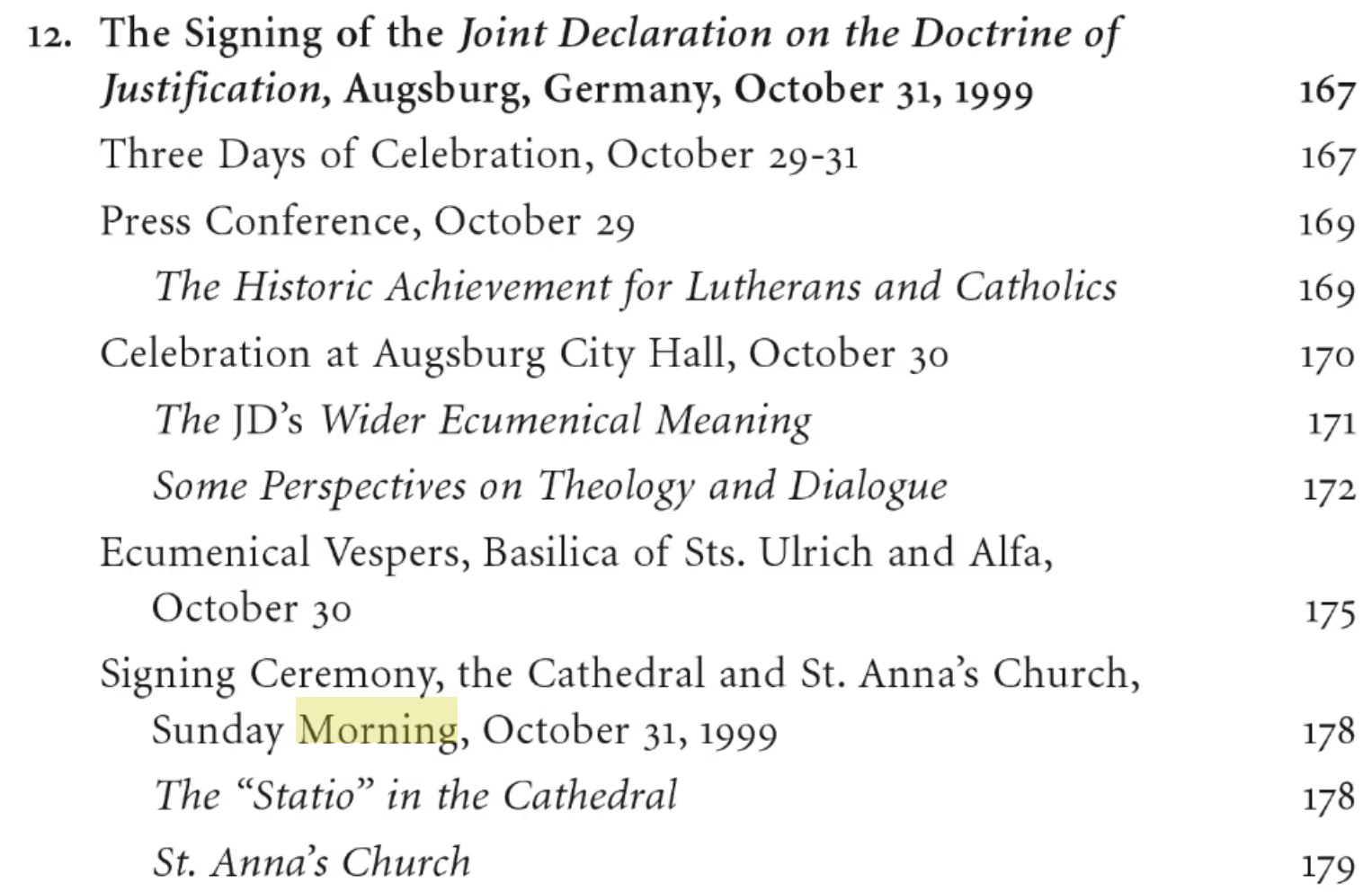
Table of contents, John A. Radano
According to the table of contents, the event spanned three days—from October 29 to 31. There was a press conference on the 29th, a commemorative event at the city hall on the 30th, and the signing ceremony took place on the morning of the 31st. The worship service on the morning of the 31st began at 9:30 a.m., emphasizing repentance for religious conflicts and gratitude for reconciliation (John A. Radano, p.178). Pope John Paul II also proclaimed a “sign” at St. Peter’s Square before noon on the same day (John A. Radano, p.180).
In conclusion, Jung Myung-seok arrived at the Duomo Cathedral after the signing ceremony had already ended.
Plausibility of the Visit
Jung Myung-seok describes his visit to the Duomo Cathedral as if he were unconsciously led there by the inspiration of the Holy Spirit. However, the Duomo Cathedral itself has little to do with the Reformation or any particular connection to it. Rather, it is one of the most famous tourist attractions in the world — a place any believer (or anyone pretending to be one) visiting Italy on a weekend might naturally choose to visit.
Some might argue, “Still, isn’t it meaningful that he visited a Catholic cathedral on October 31?” Yet October 31 is not a random date — it commemorates October 31, 1517, the day the Protestant Reformation began. Thus, it is entirely possible that after hearing “today is Reformation Day” following the Sunday service, he decided to act on that information.
Furthermore, Jung wrote that he only learned about the event (the signing of the Joint Declaration) three days later through a newspaper. Within JMS, this is interpreted as “God showing His servant the news.” However, if such “realizations of miracles three days later” occur repeatedly, it raises the suspicion that these stories were retroactively constructed. The claim that he resolved misunderstandings about Mary through a conversation with a Catholic priest also appeared years later in his sermons, suggesting it could have been a later interpretation shaped after learning about the declaration.
Above all, such a major event would never have been organized on impulse. The following article shows that the ceremony schedule had been announced weeks in advance.
Officials of the Roman Catholic Church and most of the world’s Lutheran churches plan to sign an agreement next week that ends a 450-year theological dispute that helped spark the Protestant Reformation.
Lutheran-Catholic Pact Is Criticized, October 23, 1999
Anderson said there is joy in noting that this century will end with a Joint Declaration on the Doctrine of Justification for Lutherans and Roman Catholics. A formal signing of the Joint Declaration will take place Oct. 31 in Augsburg, Germany.
ELCA Assembly Hears Bishop Address Legacies for the next Millennium, October 17, 1999
The Core Content of the Joint Declaration
How closely is the misunderstanding Jung Myung-seok claimed to have resolved related to the contents of the Joint Declaration? The central message of the declaration concerns the fundamental truth of how sinners are saved—that salvation comes through faith by the grace of God. In contrast, Jung summarized it as “Both Catholics and Protestants are saved in the name of Jesus.” The word grace is missing, reflecting that Jung’s doctrine of salvation differs from orthodox Christianity, and more importantly, that he failed to grasp the core meaning of the declaration.
Jung also focused heavily on the issue of the Virgin Mary. However, the Joint Declaration makes no mention of the Virgin Mary. Despite decades of dialogue, the two sides could not narrow their differences on the roles of Mary, the saints, or the Vatican.
Furthermore, Jung presented himself as if he were mediating between the two sides. Yet his statement — “It’s fine to pray to the Virgin Mary and the saints, but it’s not necessary” — is too simplistic and fails to gain support from either side. The real issue lies in whether devotion to Mary helps believers draw closer to Christ or instead diminishes His significance.
Beyond that, Jung’s remark that “There is no need to pray to Mary” carries an ulterior motive. Jung has long claimed to be a new messianic mediator. Through this claim, he implies that he himself has now taken on the role of intercessor. In his view, while Mary’s intercession may once have been helpful, believers should now invoke Jung Myung-seok’s name instead of Mary’s.
Within JMS, it is taught that their faith stands on a higher level than Catholicism, and that JMS is the next stage of Protestantism—continuing and transcending its tradition. Thus, Jung often speaks as if he represents the Protestant position. However, his willingness to acknowledge even a partial role for Mary shows that his teaching can no longer be regarded as Protestant.
If Jung truly intended to complete his narrative of reconciliation, where should he have gone, and whom should he have met? Instead of visiting the Duomo Cathedral—which has no historical connection to the Reformation—and conversing with a Catholic priest, he should have visited a church in Switzerland or Germany, directly linked to the Reformation, to persuade a pastor there and make him his disciple.
Summary
In summary, the signing ceremony had been planned in advance and was held over three days, from October 29 to 31, along with various related events. The signing itself took place on the morning of the 31st, and Jung Myung-seok arrived at the Duomo Cathedral only in the afternoon that day. Furthermore, he failed to grasp the core content of the declaration.
- John A. Radano, Lutheran and Catholic Reconciliation on Justification, Eerdmans (July 28, 2009)
Note
The translated portions of this text were generated using machine translation and may contain unnatural expressions or errors.