When the Leader in Heaven Changes, Does the Leader on Earth Change Too?
JMS’s Theory of History
Jung Myung-seok cited the words of the prophet Daniel to link his divine mission to specific periods of time.
According to him, his mission began in June 1978, and after 21 years (three periods of seven years each), a tribulation period would arrive.
He claimed that the tribulation would begin in June 1999, saying, “Just as Peter denied Jesus, there will come a time when people deny Jung Myung-seok.”
This period was called the “Grave Period,” which he likened to Jesus’s three and a half days in the tomb—interpreting it as three years and six months.
After another three cycles of seven years, he said, the year 2023 would come—the year in which the Providential History would be completed, or the Complete Testimony fulfilled.
According to his claim, the timeline was as follows:
| Start | End | Duration | Name |
|---|---|---|---|
| June 1978 | End of May 1999 | 21 years | First Half |
| June 1999 | End of 2002 | 3 years 6 months | Grave Period |
| Early 2003 | End of 2023 | 21 years | Second Half |
A Reality Contrary to His Prophecy
Reality, however, unfolded quite differently from his predictions.
Even before the so-called Grave Period began, Jung Myung-seok became embroiled in growing sexual-misconduct allegations.
On January 7, 1999, the Hwangyang Kidnapping Case made national headlines, and the very next day, January 8, he fled South Korea—coincidentally just before reporters arrived at Wolmyeongdong.
This incident made JMS the target of widespread public criticism, effectively moving the start of the Grave Period six months earlier than his prophecy had stated.
Nevertheless, JMS followers interpreted the public condemnation as “spiritual persecution.”
They believed that “after three years and six months, all misunderstandings will be resolved,” but instead, Jung continued to cause further controversy overseas, amplifying the scandal’s global reach.
In the end, even after 2003, the Grave Period did not end.
In February 2008, Jung Myung-seok was forcibly extradited to South Korea and sentenced to ten years in prison.
Revision of the Historical Theory
Many believed this would mark the end of JMS—but reality turned out differently.
JMS created a new narrative: “Jung Myung-seok is enduring suffering in prison.”
Using this story, the group began recruiting new followers once again.
Around 2009, JMS began emphasizing Jesus, highlighting similarities with mainstream Christianity.
However, over the course of hundreds of sermons, the message gradually shifted to emphasize Jung Myung-seok’s own authority.
Then, in 2012, JMS declared a spiritual victory, proclaiming that “Jung Myung-seok has inherited the baton from Jesus.”
The many signs and omens that occur on earth in 2012 are the works of the Son, acting according to God’s appointed time.
In other words, God’s new history has gone beyond the period of times, times and half a time, and thus, various signs will appear in 2012.
(…)
In this year, 2012, the sovereign rulers of about twenty great nations—including Korea, the spiritual center, as well as China, the United States, and Russia—will change. The leaders of the earth will change. And from 2013 onward, administrations will change as well.
The leader on earth will change, and the leader in heaven will also change. Through the Son, the “First Coming New Testament Era of the Son” will completely shift into the “Second Coming Complete Testimony Era of the Bride,” and the history of the Complete Testimony will become independent.— “2012 and the Clock of History,” Sunday Sermon, June 3, 2012
In this sermon, Jung Myung-seok declared that the period of times, times and half a time had ended,
announcing the complete end of the Grave Period.
According to him, the years from 1999 to 2012 represented a time of spiritual warfare,
and he had now triumphed in that battle and inherited the throne from Jesus.
Signs of History: The Changing of Leaders
As evidence of this “victory,” Jung pointed to what he claimed was a wave of leadership changes among major nations in 2012.
One of the “two witnesses,” Jung’s younger brother Jung Beom-seok, supported this claim, saying,
“There were also many global leadership changes in 1978.”
At first glance, this might have seemed persuasive in mid-2012.
Indeed, several countries—including Korea, the United States, China, and Japan—had presidential or leadership elections scheduled that year.
Superficially, it may have appeared to be a “turning point in history.”
However, a closer look quickly refutes his claim.
For instance, in the United States, the symbolic center of global politics,
Barack Obama was re-elected in the 2012 presidential election.
There was an election, but the leader did not change—invalidating the prophecy’s key premise of a “leadership shift.”
In Russia, the situation was slightly more complex.
While power formally transferred from Medvedev to Putin in May 2012,
real authority had always remained with Putin.
Critics even called it a “rotating dictatorship” between Putin and Medvedev.
Thus, it is difficult to regard this as a true “sign of leadership change.”
Finding the Turning Point of Leadership Changes
Now, let us test Jung Myung-seok’s claim about the “approximately twenty great nations.”
To objectively evaluate whether his statement holds true, we can analyze when leadership changes were most concentrated among countries of comparable scale—namely, the G20 member nations.
The data were collected from Wikipedia’s “List of Presidents of [Country Name]” pages.
After compiling the leadership change dates for each country,
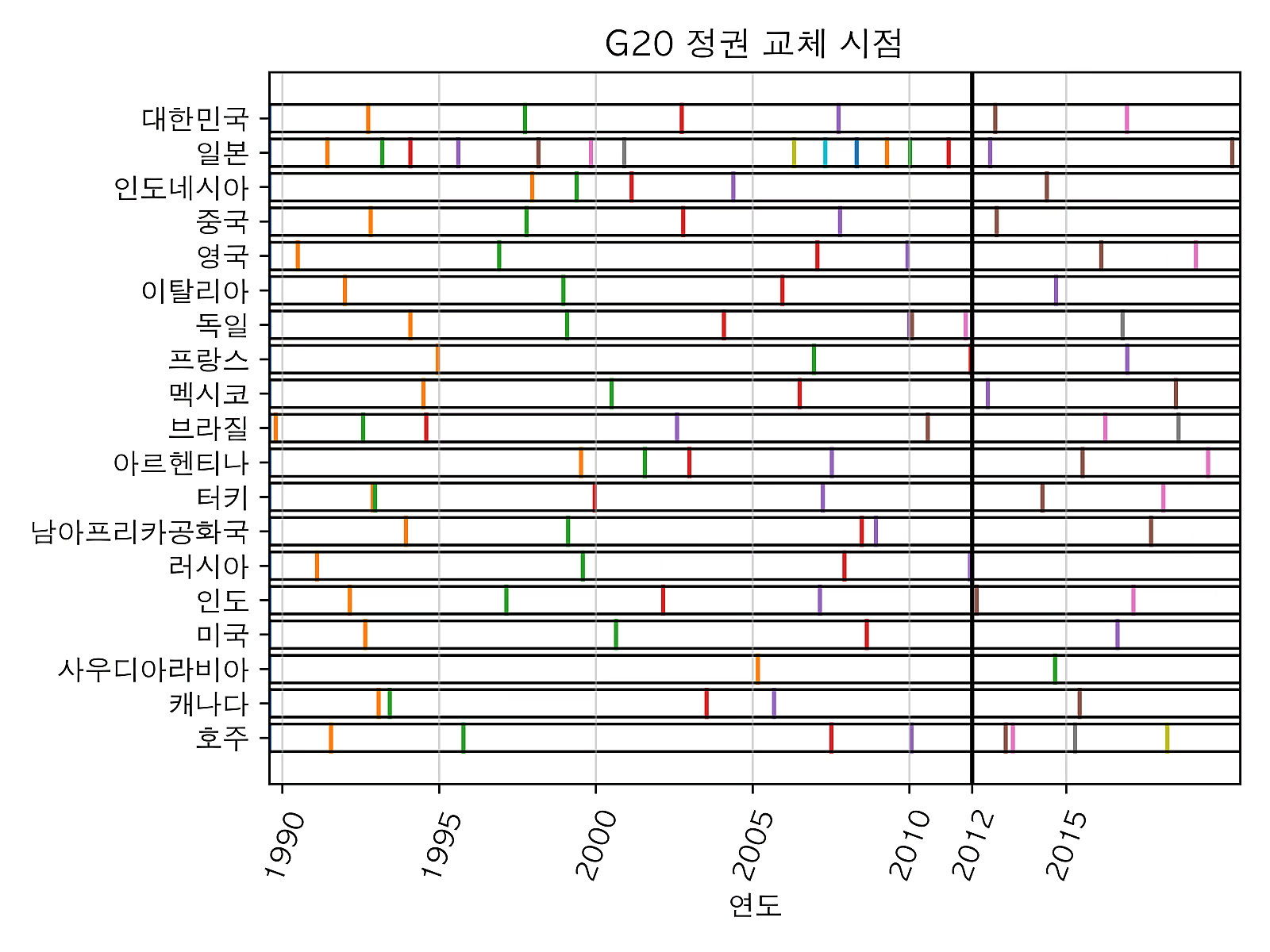
the timing of leadership transitions across the G20 was visualized.
The analysis covers the period from 1950 to 2020.
In the plots below, the color of each bar represents the ordinal number of the administration from a given starting point.
Thick black vertical lines mark June 1978 and June 2012.

Timing of G20 Leadership Changes, 1950–1989
No noticeable concentration of leadership changes appears around 1978.
Even by eye, one can easily spot periods with far more frequent transitions.
Timing of G20 Leadership Changes, 1990–2020
Around 2012, there are indeed several leadership transitions.
However, as discussed earlier, once Russia is excluded, this period hardly stands out as unique.
Next, a quantitative calculation was performed to find when the highest number of leadership changes occurred
between January 1950 and December 2020.
The algorithm is as follows (for simplicity, let’s first consider just South Korea and the United States):
- Select a specific time point t.
Example: t = October 13, 2007 - For each country, find the leadership change date closest to t.
Example: South Korea = Feb 25, 2008; U.S. = Jan 20, 2009 - Compute the time difference between t and each change date, then take the average.
Example: Korea = 135 days; U.S. = 465 days; Average = 300 days - Plot the resulting average value over time.
The smaller this average, the more concentrated leadership changes are around that point;
larger values indicate fewer transitions nearby.
Repeating this calculation for each day from Jan 1, 1950 to Dec 31, 2020 across all 19 G20 nations yields the following:
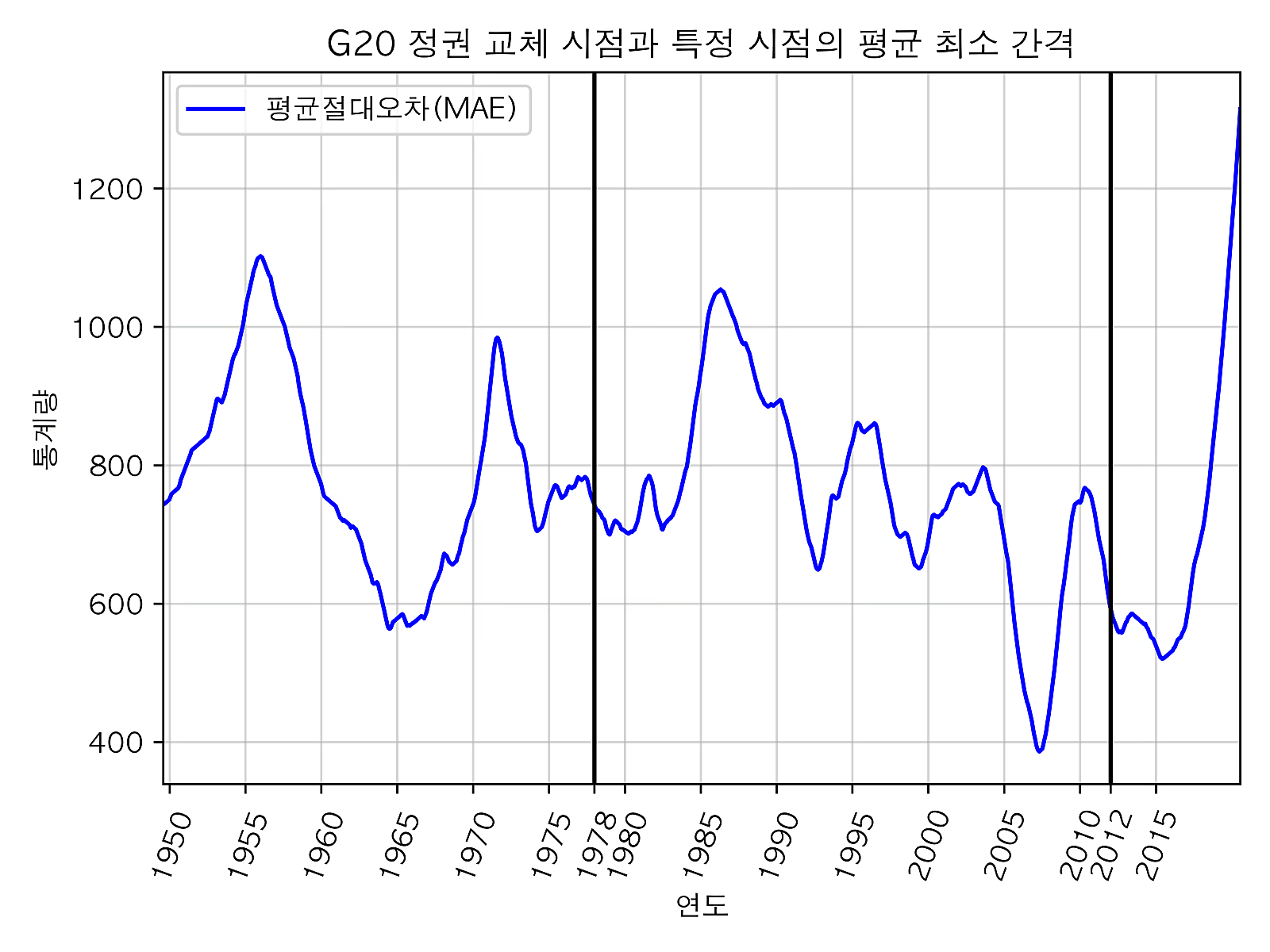
Average Absolute Time Difference in G20 Leadership Changes
※ Smaller values on the y-axis mean more leadership changes occurred nearby.
This reveals immediately that 1978 and 2012 are not particularly special points.
While 2012 may look moderately active, it is far from being the peak.
Without Russia, it becomes an entirely ordinary year.
Using a local minimum–finding algorithm, the following periods of concentrated regime change were identified:
- December 1, 1964
- June 4, 1979
- February 25, 1993
- October 20, 1999
- September 26, 2007
- November 4, 2015
To address the issue that long dictatorships can skew the average upward,
the calculation was repeated with a maximum difference threshold of 180 days (six months)—
that is, any difference beyond six months is treated as equal to six months.
3’. Compute the differences and take the average, but cap each at 180 days.
Example: Korea = 135 days; U.S. = 180 days (originally 465); Average = 157.5 days.
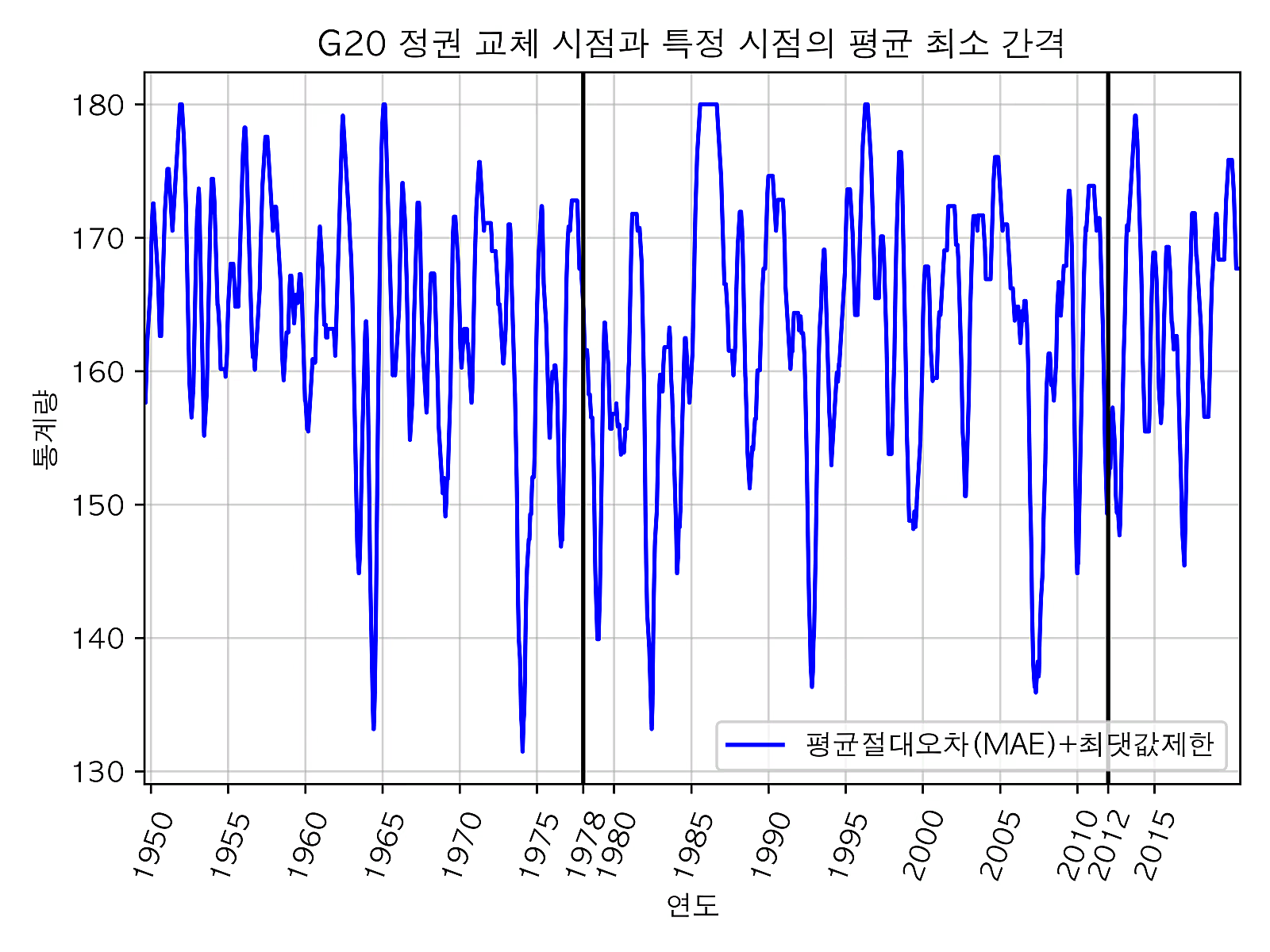
Average Absolute Time Difference with Max Cap (180 days)
※ Again, smaller y-axis values indicate denser leadership changes.
No distinctive pattern appears here either.
Many other periods show higher concentrations than 1978 or 2012.
Using the same minimum-search algorithm, we find:
- November 14, 1953
- March 27, 1993
- October 20, 1999
- September 26, 2007
- May 10, 2017
Thus, neither 1978 nor 2012 stands out as a remarkable turning point.
Additional statistical methods—using the median instead of the mean,
or employing ±1 standard deviation of the normal quantile range—
produced similar results.
Conclusion
Jung Myung-seok claimed that he had meticulously calculated Biblical numbers,
asserting that his Theory of History was mathematically precise.
Yet in reality, events consistently diverged from his prophecies,
forcing him to repeatedly revise his doctrine.
The 2012 version of his historical theory, in particular,
introduced the Grave Period four separate times in an effort to fit the timeline,
but the “signs” he cited ultimately proved to be fabrications.
Even so, followers found it difficult to break away from such teachings.
One reason is that understanding JMS’s doctrine takes a long time.
It already requires considerable effort to learn the current theology,
let alone to trace its historical transformations.
Another reason lies in the asymmetry of verification.
Making a claim is easy, but disproving it demands far more time and labor.
To refute even a single baseless assertion—like
“In 2012, the leaders of twenty great nations will change”—
one must go through extensive data collection and analysis, as demonstrated here.
Note
The translated portions of this text were generated using machine translation and may contain unnatural expressions or errors.